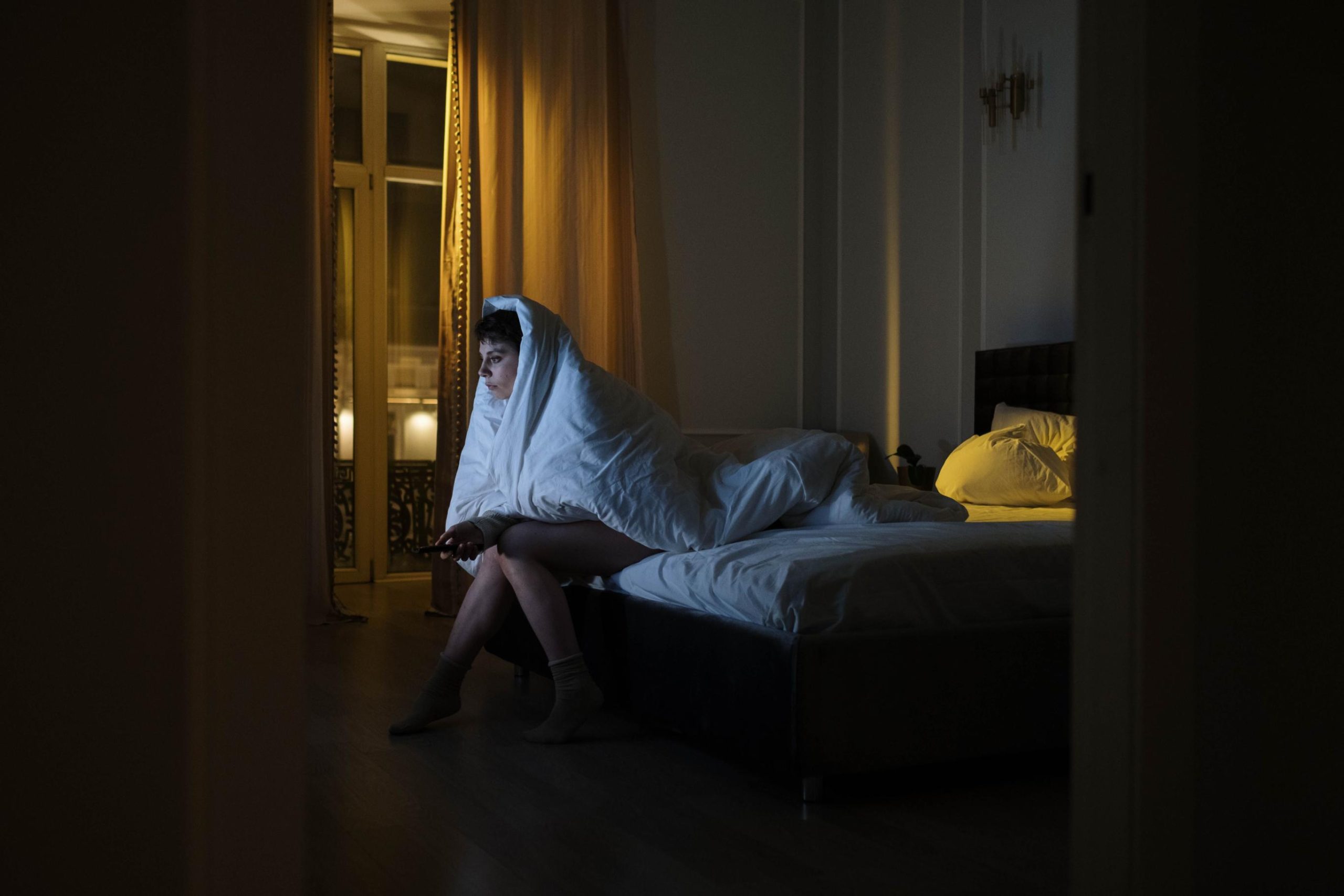
Feeling completely drained but still lying awake has a name: tired but wired, a genuinely recognisable pattern rather than a contradiction. This article explains what’s actually happening in your body when exhaustion and sleeplessness happen at the same time, and what genuinely helps.
You’ve been running on empty all day. Your eyes are heavy by nine. You finally get into bed, certain you’ll be asleep within minutes. And then nothing happens. You lie there, wide awake, more alert than you were an hour ago, wondering how you can be this exhausted and this unable to switch off at the same time.
If this sounds familiar, you’re not imagining it, and you’re not doing something wrong. There’s a real physiological reason exhaustion and sleeplessness can happen together, and understanding it is usually the first step towards actually fixing it.
I qualified as a hypnotherapy practitioner in 2003 and trained as a cognitive hypnotherapist at the Quest Institute. I specialise in sleep, stress and executive performance, and sleep is one of the areas that comes up constantly in my practice, precisely because it’s so often tangled up with everything else I treat. As a hypnotherapist for insomnia in London and online, I find that people rarely arrive saying their sleep is the problem in isolation. It’s usually sitting downstream of stress, pressure at work or a mind that has learned to stay switched on.
What Is the ‘Tired But Wired’ Cycle?
Tiredness and sleepiness are not the same thing, even though it feels like they should be. Tiredness is your body telling you it needs rest. Sleepiness is your brain’s actual readiness to fall asleep. When you’re exhausted but wired, your body is genuinely depleted, but your nervous system is still running in a state of alert that overrides the physical signal to switch off.
This usually comes down to cortisol and adrenaline, the same hormones designed to keep you alert and functioning under pressure. In a normal day, cortisol rises in the morning and gradually tapers off by the evening, making room for melatonin, the hormone that actually signals sleep. When stress has been running for a while, cortisol stays elevated into the night instead of dropping, so your body remains in a low-grade version of fight or flight right at the moment it should be winding down.
That’s the paradox. You can be utterly depleted and still biologically primed to stay awake, because part of your nervous system hasn’t been told the day is over.
Why Does This Happen More When You’re Stressed or Anxious?
Stress and anxiety are two of the most common drivers of this pattern, and they work on sleep in a very direct way. A nervous system that has spent the day scanning for problems, replaying conversations or anticipating what’s next doesn’t get a clean switch to flip once you’re in bed. It simply keeps doing what it’s been doing all day, just now with nothing external to focus that alertness on, which often means it turns inward instead.
This is also why lying in the dark can feel worse than the day itself. Without the distractions of work, conversations or tasks, the mind that’s been held together by momentum all day suddenly has nothing to do except notice everything it didn’t have time to feel earlier.
What Are the Different Types of Sleeplessness?
Not everyone experiences this the same way. There are three broad patterns worth recognising, because they often point to slightly different underlying causes.
- Difficulty falling asleep in the first place, even when you’re shattered the moment you get into bed
- Waking during the night and struggling to drop back off, often with the mind immediately alert
- Waking very early, well before you need to, and being unable to get back to sleep at all
Any of these can happen alongside genuine physical exhaustion. The common thread is a nervous system that hasn’t been given the signal, or the tools, to actually stand down, not a lack of tiredness.
Why Doesn’t Just Being More Tired Fix It?
A common assumption is that if you’re tired enough, sleep will eventually take over. For a lot of people, the opposite happens. Push past your natural window for sleep, and the body can trigger a second wind, releasing more cortisol and adrenaline to keep you functioning, which makes falling asleep even harder once you finally get the chance.
This is also why simply trying harder to sleep rarely works. Willing yourself to relax activates the very part of the mind that’s already overactive. The harder you try, the more alert you often become, because trying is itself a form of mental effort your nervous system registers as work rather than rest.
How Can Hypnotherapy Help?
Hypnotherapy for insomnia works differently to simply trying harder to relax. Rather than telling yourself to switch off, which rarely works when the nervous system is the thing driving the alertness, the work focuses on reprogramming that underlying stress response directly, so your body can enjoy the drop in cortisol it needs to let melatonin do its job.
In practice, this often involves a hypnotic induction to interrupt the alert state, working with the specific thoughts or associations keeping your mind active at bedtime, and building new positive subconscious associations between bed and genuine rest, rather than bed and lying awake. For many people, the shift comes less from learning a new technique and more from finally giving an overactive nervous system permission, and the means, to stand down.
Frequently Asked Questions
Is being tired but unable to sleep a sign of something serious?
Occasionally, yes, and it’s worth ruling out. Persistent sleeplessness alongside exhaustion can sometimes point to an underlying sleep disorder, depression or a medical issue, so if it’s severe, long-standing or affecting your daily functioning significantly, it’s worth speaking to your GP alongside any other support you seek.
Why do I feel more awake the later it gets, even though I’m exhausted?
This is common, and it’s usually the second-wind effect. Pushing past your natural sleep window can trigger another release of alerting hormones, which is why going to bed the moment you first feel sleepy often works better than waiting.
Can this happen even if I don’t feel consciously stressed?
Yes. The nervous system can hold onto a state of alertness even when you don’t consciously feel anxious or wound up. Plenty of people who’d describe themselves as calm during the day still find their body won’t switch off at night.
How is this different from general sleep hygiene advice?
Sleep hygiene, consistent bedtimes, less screen time, a cool dark room, genuinely helps and is worth doing regardless. It addresses the environment around sleep. It doesn’t necessarily reach a nervous system that’s stuck in alert mode, which is the layer that hypnosis for sleep issues is aimed at.
Final Thoughts
Lying awake when you’re exhausted is usually a nervous system that’s still switched on well after your body needed it to switch off, not a failure of willpower or a sign that something is wrong with how tired you are.
Once you understand that the problem is an excess of alertness rather than a lack of tiredness, the solution looks quite different to simply trying harder to sleep. It looks like helping your body find its way back to actually standing down.
If you have been wondering “Why can’t I sleep even though I’m exhausted”, and you are ready for proper support, you’re welcome to get in touch to arrange an initial consultation here.
