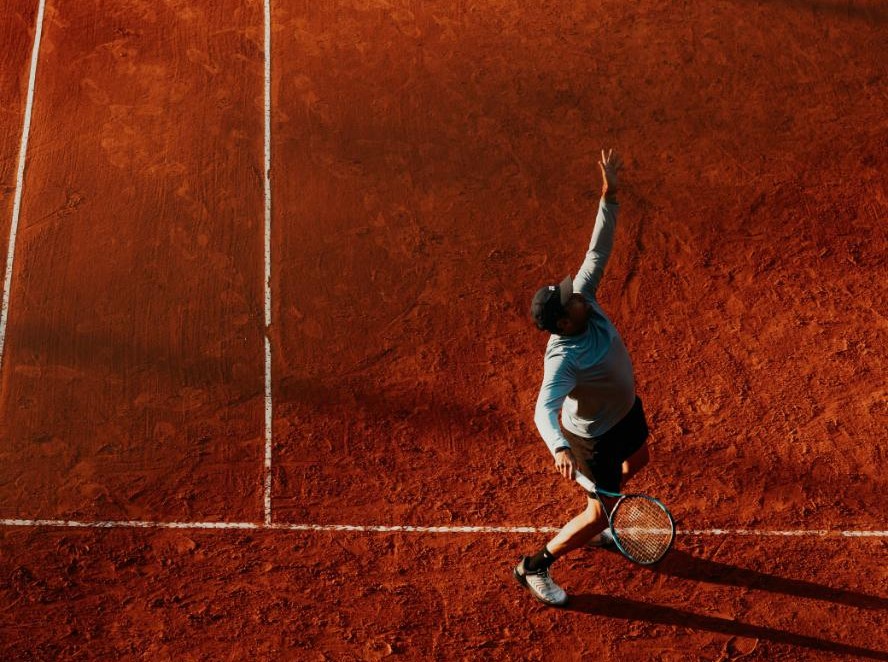
Roger Federer won almost 80 per cent of the professional singles matches he played. Yet across his career, he won only 54 per cent of the individual points.
One of the greatest tennis players of all time still lost almost half the points he contested. His success was not built on avoiding mistakes. It was built on what happened in his mind after each mistake.
Federer described the principle simply: when we are playing a point, it must feel like the most important thing in the world. Once it is behind us, it needs to be left behind. The only point that matters is the next one. That idea sits at the heart of the “Next Point” sequence.
This is also one of the central aims of hypnotherapy for sports performance.
Whether we play golf, tennis, football, cricket or another sport, our technical ability is only part of the equation. We must also be able to access that ability when we are being watched, when the score matters and when the previous moment has not gone as planned.
Hypnosis can help us interrupt the mental replay of the last shot, settle the body and return our attention to what is actually happening now. Not by making us indifferent to performance, but by helping us carefully about this moment without carrying every previous moment into it.
Understanding the Issue
Most sporting mistakes last only a second or two. The psychological consequences can last much longer.
A golfer misses a short putt and arrives at the next tee still seeing the ball slide past the hole. A tennis player double-faults and begins the next service game trying not to do it again. A footballer misses a chance and becomes slightly more hesitant when the next opportunity appears.
The original mistake has ended. Yet our nervous system may still be responding as though it is happening.
We replay the movement. We criticise ourselves. We imagine what other people are thinking. We become aware of our technique in a way that makes a previously automatic action feel complicated.
Instead of seeing the next shot clearly, part of our attention remains behind us.
When conscious control gets in the way
Well-practised sporting movements are usually performed through learned patterns. We do not consciously calculate every joint angle involved in striking a ball or taking a golf swing. The movement has been rehearsed until much of it can occur automatically.
Under pressure, however, we may begin trying to control consciously what our body already knows how to do.
A golfer starts thinking about six different components of the swing during the backswing. A tennis player tries to guide the serve into the court. A footballer approaches a penalty thinking about where not to place it.
The instruction “do not miss” still requires the mind to represent missing.
The more urgently we attempt to prevent a particular outcome, the more mentally available that outcome can become. Our attention moves away from the target and towards the feared mistake.
This does not mean technique is unimportant. Technical analysis belongs in practice, coaching and deliberate correction. Competition usually requires something different: trust in the preparation that has already taken place.
The body remembers pressure
Performance anxiety is not confined to our thoughts. It may appear as shallow breathing, muscular tension, a racing heart, narrowed attention or a feeling that we need to rush.
These responses are understandable. The nervous system is preparing us for something important.
The difficulty arises when useful activation becomes excessive. Fine motor control may feel less fluid. Our awareness may become fixed on one threat. We may struggle to make flexible decisions because our mind is trying to protect us from another error.
This is why simply telling ourselves to relax rarely solves the problem. We are not dealing only with a sentence in the conscious mind. We are dealing with an entire learned response involving attention, expectation, emotion and physiology.
Why the Usual Approaches Fall Short
Athletes are often told to be more confident, stop thinking about the mistake or concentrate harder.
These are sensible intentions. They are not always workable instructions.
If we already knew how to stop replaying the missed putt, we would probably have done so. If confidence could be restored by demanding it from ourselves, sporting performance would be considerably simpler.
Willpower can become another contest
When we try to force ourselves not to feel nervous, we can inadvertently create a second struggle.
First, we experience the normal pressure of competition. Then we become concerned that we are experiencing pressure at all.
We might think:
“I should not be feeling like this.”
“I must calm down.”
“Why am I doing this again?”
Now we are playing the opponent, the course or the match while also fighting our own internal experience.
Effective mental performance does not always require us to eliminate activation. It requires us to use it differently. The sensations we interpret as anxiety are often close to those associated with readiness, anticipation and energy.
The goal is not necessarily to become completely calm. It is to reach the state that allows us to perform this particular task well.
Positive thinking is not the same as embodied confidence
Repeating positive statements can sometimes be helpful. Yet words alone may have limited impact when our body is communicating something entirely different.
Telling ourselves “I am confident” while gripping the club tightly, holding our breath and imagining failure creates an internal contradiction. Confidence is more than a belief about the future. It is also a physical and attentional state.
It may be experienced as steady breathing, an open field of vision, a clear intention and a willingness to complete the movement without interfering with it.
This is one reason mental performance hypnotherapy can be useful. Rather than attempting to argue with anxiety, we can work with the imagery, sensations and automatic associations through which the response is being maintained.
How Hypnotherapy Helps
Hypnosis is a state of focused attention in which we can become more absorbed in internal experience and more responsive to purposeful suggestion.
In sport, clinical Hypnosis for Sports Performance, can provide a structured setting in which we mentally rehearse performance, regulate activation and strengthen the association between a chosen cue and a useful performance state.
Hypnosis should therefore be understood as a potentially valuable performance tool rather than a guaranteed route to improvement. After all, hypnosis cannot install skill that is not there, it can however serve to optimise reliable access to that skill and help to engender a ‘flow state’.
Releasing the previous point
For many athletes, the most valuable skill is not avoiding every negative reaction. It is shortening the time required to recover.
Through hypnosis for sports performance, we can rehearse a clear psychological ending to each point, shot or phase of play.
We might imagine the previous moment becoming more distant as we exhale. We may associate a physical action, such as adjusting a grip, touching a wristband or stepping behind the ball, with the instruction:
“That point is complete. Now on to this one.”
The action becomes a boundary between what has happened and what is about to happen.
With repetition, this can develop into an automatic reset routine. We notice the reaction, take the information we need and allow the emotional residue to pass.
We do not pretend the mistake was successful. We simply stop asking it to determine what happens next.
Creating the right level of activation
Relaxation in sport does not mean becoming sleepy or passive.
A sprinter requires a different state from a golfer facing a tricky fairway shot. A goalkeeper facing a penalty needs a different balance of energy and stillness from an archer releasing an arrow.
In hypnosis, we can explore the individual athlete’s best performance state. We may recall a time when movement felt instinctive, attention was clear and the body responded without unnecessary effort.
The sensations associated with that memory can then be strengthened and connected to a simple cue.
This may be a word, a breath, a movement or a particular focal point in the environment. The aim is to create a reliable route back towards the desired state.
Mentally rehearsing successful responses
Mental rehearsal is not simply imagining that we win.
It can include seeing, feeling and experiencing the process through which we perform effectively. We can rehearse the pre-shot routine, the movement, the recovery and the transition to the next task.
Crucially, we can also rehearse responding well when something goes wrong.
We might imagine losing a point, noticing disappointment and then resetting quickly. We might mentally experience an opponent gaining momentum while we remain connected to our own process. We might rehearse an unexpected interruption and see ourselves adapting calmly.
This prepares us not for a perfect contest, but for a real one.
Strengthening attentional control
Research on mindfulness in sport supports the value of present-moment attention, acceptance and reduced rumination. Hypnosis and mindfulness are not identical. They can, however, share some useful qualities: focused awareness, reduced engagement with distracting thoughts and a return to immediate sensory experience.
Hypnosis to improve focus in sport may direct attention towards the relevant cues:
The feel of the grip.
The movement of the opponent.
The space into which the ball will travel.
The rhythm of the run-up.
The next useful decision.
When attention is placed here, there is less room for the audience, the score and the previous mistake to dominate awareness.
Developing confidence that survives mistakes
Fragile confidence says: “I can feel confident when everything is going well.”
Robust confidence says: “Whatever happens, I know how to respond.”
This distinction matters. We cannot control every bounce, decision, opponent or condition. When confidence depends on complete control, it is easily disturbed.
Hypnosis for sports confidence can help us shift confidence away from the promise of a perfect outcome and towards trust in our response.We can trust our preparation.
We can trust our ability to reset.
We can trust ourselves to remain involved even after an error.
Confidence then becomes less like a mood we hope will appear and more like a practised way of returning to the task.
What to Expect in Sessions
Sports hypnotherapy should be collaborative, practical and specific to the athlete.We begin by understanding the sport, the performance environment and the exact moments in which the problem appears.
“Losing confidence” may mean different things for different people. One athlete may rush after a mistake. Another becomes cautious. Another experiences physical tension while someone else becomes absorbed in internal criticism.
We therefore look closely at the sequence:
What tends to trigger the reaction?
What do we notice in the body?
What pictures or words appear internally?
What happens to our breathing, timing and decision-making? What would we prefer to experience instead?
The hypnotic work may then include relaxation, focused attention, imagery, mental rehearsal, reframing and the development of a performance anchor or reset cue.
For someone seeking hypnotherapy for performance anxiety, sessions may also explore the meaning attached to competition. Sometimes the apparent fear of missing is connected to a deeper concern about judgement, disappointment or not being good enough.
When that emotional loop softens, the sporting situation may begin to feel less like a test of our worth and more like an opportunity to play.
Hypnotherapy does not replace technical coaching, physical preparation or appropriate psychological and medical support. It works alongside them, helping us access the skills we have already developed with greater freedom and consistency.
Self-hypnosis recordings may also be used between sessions. Regular rehearsal allows the preferred state and reset routine to become increasingly familiar before they are needed in competition.
Practical Steps You Can Try Now
Give each moment a clear ending
After a shot or point, take one deliberate breath. As you exhale, use a brief phrase such as:
Finished.
Release.
Next point.
Let the exhalation mark the end of the previous event. This does not require us to approve of what happened. It simply signals that the information has been received and the moment is complete.
Use a three-stage reset routine
Create a routine that takes only a few seconds:
Release: Exhale and soften unnecessary tension.
Orient: Look at something physically present, such as the ball, target or playing area. Commit: Decide what you want to do next.
Pre-performance routines have been associated with improved sporting performance in both lower-pressure and pressurised conditions. Their value may come partly from directing attention towards controllable and task-relevant actions.
Replace outcome language with action language Instead of saying:
“Do not miss.” Choose an instruction the body can perform:
See the target.
Smooth through the ball.
Move early.
Complete the follow-through.
The mind responds more effectively to a clear action than to the absence of an unwanted outcome.
Practise recovery during training
Do not mentally rehearse only perfect performance.
Deliberately introduce small challenges. Start a practice game from behind. Add a consequence to a shot. Pause unexpectedly. Imagine a disputed decision.
Then practise the reset.
Our aim is to make recovery familiar rather than hoping it will appear spontaneously under pressure.
Remember a genuine performance state
Recall a specific occasion when we performed with confidence, freedom or complete concentration.
Notice what we saw, heard and felt. Pay attention to posture, breathing and the quality of movement.
As that experience becomes clearer, connect it to a small physical cue, such as pressing finger and thumb together.
Repeat this several times in practice. Over time, the cue may help us reconnect with elements of that state.
Ask one useful question
When we notice ourselves analysing the previous error, ask:
What does this next moment require from me?
Not what does the match require.
Not what will people think.
Not what if it happens again.
Just this moment.
If this resonates with you, I’d love to welcome you to explore more about my work here.
And if you feel ready to take the next step, you can book an initial session with me here.